
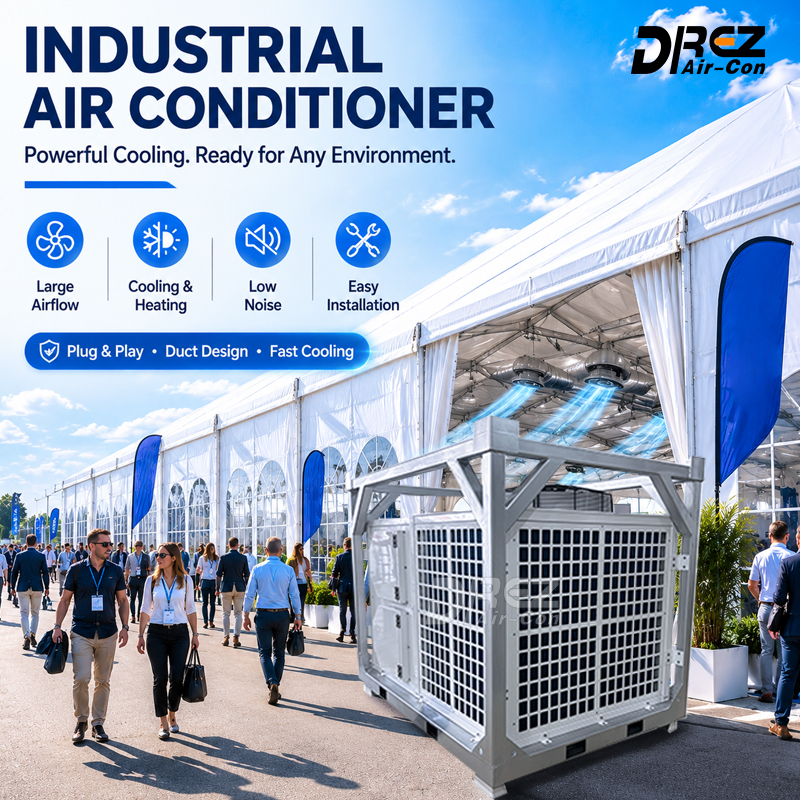
Why Large Temporary and Industrial Spaces Need Specialized Cooling
Climate control challenges in large-volume environments are very different from those found in conventional enclosed spaces. Warehouses, air domes, event venues, exhibition structures, camps, inflatable buildings, greenhouses, aviation facilities, churches, marine applications, emergency relief shelters, wedding marquees, sports facilities, desert installations, and production environments often require powerful airflow, rapid temperature reduction, and flexible installation methods.
Traditional cooling solutions are frequently designed around fixed infrastructure and may not adapt efficiently to changing layouts or temporary structures. In contrast, packaged commercial and industrial air conditioning systems from 3 to 60 tons are engineered to support demanding operational conditions while maintaining consistent airflow distribution through ducted delivery systems.
If your project requires fast deployment and dependable cooling performance across a large footprint, keep reading. The next sections explain why more project planners are choosing packaged floor-standing and rooftop-ready systems for challenging environments. Request a cooling solution assessment to explore the most suitable configuration for your application.
Understanding Packaged Commercial and Industrial Air Conditioning
A packaged air conditioning system integrates major cooling components into a single unit. Instead of requiring multiple separate assemblies across different locations, the system arrives as a complete solution ready for connection to power and ductwork.
This integrated approach offers significant advantages for commercial and industrial users:
- Simplified deployment procedures
- Reduced on-site installation complexity
- Flexible airflow distribution through ducts
- Reliable cooling performance for large spaces
- Streamlined maintenance access
- Adaptability to temporary and semi-permanent structures
For facilities that need rapid operational readiness, a packaged design can shorten preparation time while helping project teams maintain construction and deployment schedules.
Applications Across Diverse Industries and Environments
Commercial and industrial packaged air conditioners serve a broad range of sectors. Their flexibility makes them suitable for both temporary and long-term deployments.
Warehouse Cooling Solutions
Warehouses often contain large open areas with varying occupancy levels and heat loads. High-air-volume systems help distribute conditioned air throughout storage and logistics zones. Ducted airflow can target specific operational areas while maintaining overall comfort.
Tent and Marquee Environments
Large tents, wedding marquees, exhibition tents, and event structures can experience rapid temperature increases during warm weather. High-capacity packaged systems provide strong airflow and quick cooling response, helping maintain a comfortable environment for guests and staff.
Many organizers look for systems that can be installed quickly without extensive site modifications. This is where integrated packaged units offer a practical advantage.
Get project-specific airflow recommendations before selecting equipment capacity for your event structure.
Air Dome and Inflatable Structures
Air domes and inflatable facilities require careful environmental management. Large interior volumes can create uneven temperature zones if airflow is not distributed correctly. Ducted cooling systems support balanced circulation while maintaining stable operating conditions.
Camp and Emergency Relief Deployments
Temporary camps and emergency relief installations often demand fast setup schedules. Packaged units with straightforward connections allow cooling infrastructure to be established efficiently when timing is critical.
Reliable operation and easy-to-operate controls become especially important in these situations, where personnel may need straightforward system management.
Medical Shelter Tents
Medical shelter tents can benefit from controlled airflow and dependable temperature management. Ducted distribution supports organized airflow pathways while helping maintain comfortable conditions for occupants and operational teams.
Factory and Production Facilities
Factories frequently generate significant internal heat loads from machinery, production lines, and industrial processes. High-capacity commercial cooling systems help stabilize environmental conditions, supporting productivity and operational continuity.
Contact our engineering team to discuss airflow planning for demanding industrial environments.
Greenhouse Temperature Control
Greenhouse operators often require dependable cooling during periods of elevated temperatures. Wide refrigeration operating ranges can support temperature management across varying seasonal conditions and climatic regions.
Aviation and Marine Applications
Aviation support areas and marine environments may present unique challenges involving airflow requirements, environmental exposure, and installation constraints. Durable packaged systems provide adaptable cooling solutions for these specialized sectors.
Sports and Public Gatherings
Sports venues, churches, exhibitions, parties, and public gatherings can experience rapidly changing occupancy levels. High airflow volume helps maintain comfort across large crowds while supporting consistent environmental control.
Key Features That Drive Performance
When evaluating commercial and industrial packaged air conditioning systems, several performance characteristics deserve special attention.
Plug-and-Play Design
A plug-and-play approach helps simplify deployment. By reducing assembly complexity, project teams can focus on site preparation and operational readiness rather than extensive equipment integration.
This feature is particularly valuable for:
- Temporary event venues
- Emergency response projects
- Seasonal operations
- Mobile business deployments
- Rapid expansion requirements
Integrated System Architecture
An integrated design combines major functional components within a single packaged structure. This can simplify logistics, transportation planning, and installation workflows.
Ducted Air Delivery
Duct systems help direct conditioned air exactly where it is needed. Whether serving a large warehouse, tent, factory, or air dome, ducted airflow improves distribution efficiency and environmental consistency.
High-Speed Cooling Capability
Large-volume spaces often require rapid temperature reduction after occupancy begins. High-speed cooling performance allows facilities to reach target conditions more quickly, reducing delays and improving user experience.
See how capacity selection affects cooling speed when planning your next project.
High Air Volume Performance
Air volume is a critical factor in large-space cooling. High airflow supports better circulation, reduces hot spots, and improves comfort across extensive coverage areas.
Low Noise Operation
While performance remains the primary objective, lower operating noise can improve the overall environment for exhibitions, religious gatherings, social events, and production activities.
Heating and Cooling Flexibility
Some projects require environmental management throughout different seasons. Systems capable of both heating and cooling provide additional versatility for changing conditions.
Wide Refrigeration Range
Environmental conditions vary significantly between deserts, coastal locations, camps, factories, and outdoor installations. A wide refrigeration operating range supports reliable performance across diverse climates.
Capacity Selection from 3 to 60 Tons
Choosing the appropriate system capacity is one of the most important project decisions. Undersized equipment may struggle to maintain target conditions, while oversized equipment can create operational inefficiencies.
Typical considerations include:
- Total area coverage
- Structure volume
- Occupancy levels
- Solar exposure
- Equipment-generated heat
- Air exchange requirements
- Geographic climate conditions
Smaller capacities around 3–10 tons may support compact structures and specialized zones. Mid-range capacities can serve medium-sized tents, camps, and industrial spaces. Larger 20–60 ton configurations are often selected for expansive warehouses, major event facilities, air domes, and large-scale industrial operations.
Request a capacity evaluation to determine the most suitable tonnage range for your specific application.
Advantages for Project Contractors and Distributors
Contractors, distributors, rental providers, and project developers frequently prioritize equipment that simplifies deployment and reduces operational uncertainty.
Packaged commercial and industrial air conditioning systems can offer:
- Streamlined logistics
- Simplified installation workflows
- Flexible placement options
- Adaptability across multiple project types
- Scalable capacity selections
- Consistent airflow performance
- Support for temporary and permanent applications
For organizations managing multiple project categories, this versatility can help standardize equipment planning across diverse environments.
Rooftop and Floor-Standing Installation Options
Different sites require different installation strategies. Packaged systems may be configured for rooftop placement or floor-standing deployment depending on project requirements.
Rooftop Configurations
Rooftop installations can help optimize ground-level space utilization while supporting efficient airflow distribution throughout the structure.
Floor-Standing Configurations
Floor-standing installations are often selected for temporary structures, camps, inflatable buildings, and event facilities where accessibility and deployment speed are priorities.
The appropriate configuration depends on structural considerations, airflow planning, maintenance access, and operational objectives.
How Fast Installation Supports Project Success
Time-sensitive projects often operate under strict schedules. Delays can impact event openings, production targets, relief operations, and seasonal business opportunities.
Fast installation capabilities contribute to:
- Earlier commissioning
- Reduced labor requirements
- Simplified project coordination
- Faster occupancy readiness
- Improved operational flexibility
When cooling infrastructure must be deployed quickly, packaged systems with integrated designs and duct-ready configurations can help accelerate project timelines.
Speak with a project specialist today to discuss installation planning for large-scale cooling requirements.
OEM and ODM Manufacturing Support
Many distributors, equipment brands, and project suppliers seek OEM and ODM manufacturing partnerships to align products with specific market requirements.
OEM and ODM support can help organizations:
- Develop branded product lines
- Address regional market preferences
- Customize technical specifications
- Expand product portfolios
- Strengthen market positioning
Manufacturing flexibility is particularly valuable for businesses serving diverse commercial and industrial sectors across multiple regions.
Choosing the Right Cooling Partner
Selecting equipment is important, but selecting the right manufacturing partner is equally critical. A dependable supplier should demonstrate experience in commercial and industrial climate control projects while offering practical technical support throughout the project lifecycle.
Key evaluation factors include:
- Manufacturing capability
- Product range availability
- Commercial and industrial expertise
- Customization support
- Quality control processes
- Global project experience
- Technical consultation services
The most successful cooling projects begin with careful planning, accurate capacity selection, and a system design that aligns with the operational goals of the end user.
Submit your project requirements to receive application-focused recommendations for warehouses, tents, air domes, camps, factories, exhibitions, sports venues, churches, emergency relief facilities, marine environments, and other demanding installations.
Future-Ready Cooling for Demanding Environments
As industries continue to expand into diverse operational settings, the need for flexible climate control solutions continues to grow. From temporary event infrastructure and emergency deployments to large-scale industrial operations and specialized facilities, packaged commercial and industrial air conditioning systems provide a practical approach to managing challenging environments.
With capacities ranging from 3 to 60 tons, integrated construction, ducted airflow distribution, rapid cooling performance, high air volume output, heating capability, easy operation, and installation flexibility, these systems are designed to support a broad spectrum of applications.
Whether your project involves a warehouse, tent, inflatable structure, air dome, camp, greenhouse, factory, church, exhibition venue, marine operation, sports facility, wedding marquee, desert deployment, or medical shelter tent, selecting the right packaged air conditioning solution can help create a stable and comfortable environment for occupants and operations alike.
Start your project consultation now and explore customized commercial and industrial cooling solutions tailored to your operational requirements.
常见问题
1. What applications are suitable for 3–60 ton packaged air conditioners?
They are suitable for warehouses, tents, air domes, camps, inflatable structures, exhibitions, factories, churches, sports venues, greenhouses, marine applications, emergency relief facilities, wedding marquees, and medical shelter tents.
2. What is the advantage of a packaged system?
A packaged system integrates major components into a single unit, helping simplify deployment, installation, and maintenance processes.
3. Can these systems work with ducting?
Yes. Ducted airflow distribution is a common feature that helps deliver conditioned air efficiently to designated areas.
4. Are these units suitable for outdoor installations?
Yes. Many commercial and industrial applications involve outdoor or semi-outdoor environments such as tents, camps, exhibitions, and temporary facilities.
5. How do I determine the correct tonnage?
Capacity selection depends on structure size, occupancy, climate conditions, heat load, airflow requirements, and operational objectives.
6. Can the systems provide heating as well as cooling?
Certain configurations support both heating and cooling functions, offering flexibility across different seasons and environmental conditions.
7. Are rooftop installation options available?
Yes. Depending on site requirements, systems may be configured for rooftop or floor-standing installation.
8. What benefits does high air volume provide?
High air volume improves airflow circulation, enhances coverage, and helps maintain more consistent temperatures throughout large spaces.
9. Do you offer OEM and ODM services?
OEM and ODM manufacturing support can be provided for distributors, equipment brands, and project suppliers seeking customized solutions.
10. Which industries commonly use commercial and industrial packaged air conditioners?
Common industries include logistics, manufacturing, events, exhibitions, agriculture, aviation support, marine operations, emergency response, sports management, and temporary infrastructure services.