
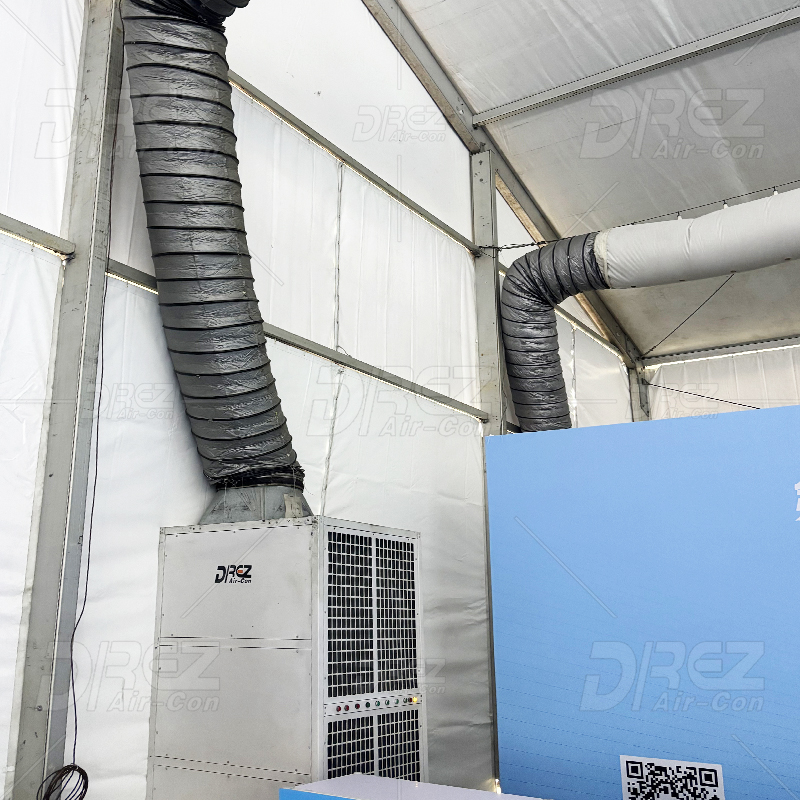
Designing an effective air conditioning system for tents is not as simple as placing a few cooling units inside. Tents are temporary, often poorly insulated, and highly affected by outdoor conditions. A well-designed system must consider cooling load, airflow distribution, equipment selection, and real application scenarios.
This guide provides a complete, practical solution based on real engineering logic.
1. What Problem Are You Solving?
Before designing any system, you need to clearly define the objective:
- What is the tent used for (exhibition, wedding, industrial use)?
- How many people will be inside?
- What are the outdoor temperature and humidity levels?
- Is the goal comfort cooling or equipment protection?
Conclusion: Different scenarios require completely different cooling strategies. There is no universal solution.
2. Why Are Tents Difficult to Cool?
Tents behave very differently from traditional buildings:
- Poor insulation (fabric structure absorbs and transfers heat quickly)
- High exposure to solar radiation
- Air leakage from doors and seams
- High internal heat load from people, lighting, and equipment
This means standard air conditioning calculations are often insufficient for tent environments.
3. Core Design Principle
An effective tent cooling system follows this formula:
Cooling Capacity + Airflow Distribution + System Stability
Key design factors include:
- Total cooling load (BTU / kW)
- Air supply distance and airflow volume
- Uniform temperature distribution
- Ease of installation and mobility
4. How to Calculate Cooling Capacity?
A simplified method for tent applications:
Step 1: Base Cooling Load
- 300–400 BTU per square meter (light use)
- 400–600 BTU per square meter (crowded or hot environments)
Step 2: Additional Load Adjustments
- +10–20% for high ceilings
- +20–30% for strong sunlight exposure
- +10–15% for high occupancy or equipment
Example: A 500㎡ exhibition tent in summer may require 250,000–350,000 BTU or more.
5. Equipment Selection (Solution Breakdown)
Different systems apply to different scenarios. The key is to match the equipment to the actual usage.
Tent-Specific Air Conditioners
- Designed for temporary structures
- High airflow and long-distance air supply
- Fast installation
Best for exhibitions, weddings, and outdoor events where quick deployment is required.
Packaged Central Air Conditioning Units
- Integrated system with stable performance
- Suitable for large areas
- Can be connected with duct systems
Recommended for large-scale or long-duration applications.
Portable Industrial Air Conditioners
- Flexible and easy to move
- Quick setup
- Minimal installation requirements
Ideal for temporary or emergency cooling needs.
Ducted Air Conditioning Systems
- Uniform air distribution
- Better temperature control
- Suitable for complex layouts
Best used when airflow organization is critical.
6. Airflow Design (Critical but Often Ignored)
Cooling capacity alone does not guarantee performance. Airflow design determines how effectively cooling is delivered.
- Ensure supply air reaches the center of the tent
- Avoid short air circulation (cold air returning too quickly)
- Design proper return air paths to prevent heat buildup
Conclusion: Poor airflow design can reduce cooling efficiency by more than 30%.
7. Real Application Scenarios
Exhibition Tents
- High crowd density
- Frequent door opening
- Requires strong airflow and high cooling capacity
Recommended solution: Tent air conditioners combined with ducted airflow systems.
Wedding Tents
- Focus on comfort and low noise
- Stable temperature control required
Recommended solution: Packaged units with balanced airflow distribution.
Industrial Temporary Spaces
- High heat load from equipment
- Continuous operation required
Recommended solution: Packaged central systems or ducted air conditioning.
8. Common Mistakes to Avoid
- Undersizing the cooling capacity
- Ignoring airflow design
- Using residential air conditioners for large tents
- Not considering extreme outdoor conditions
These mistakes often lead to poor cooling performance and user dissatisfaction.
9. Content Linking Strategy
To build a complete content system, this article should connect to related topics such as:
- How to cool a large tent effectively
- How to choose the right tent air conditioner
- Tent air conditioner cost analysis
- Industrial cooling solutions for temporary structures
This creates a structured knowledge network and improves SEO performance.
10. Final Summary
Designing a tent air conditioning system is a systematic engineering process, not just equipment selection.
- Start from real usage scenarios
- Calculate cooling load accurately
- Select appropriate equipment
- Optimize airflow distribution
Only by combining these elements can you achieve stable, efficient, and comfortable cooling performance in tent environments.
If your goal is reliable performance in real-world conditions, system design is far more important than simply choosing a product.