
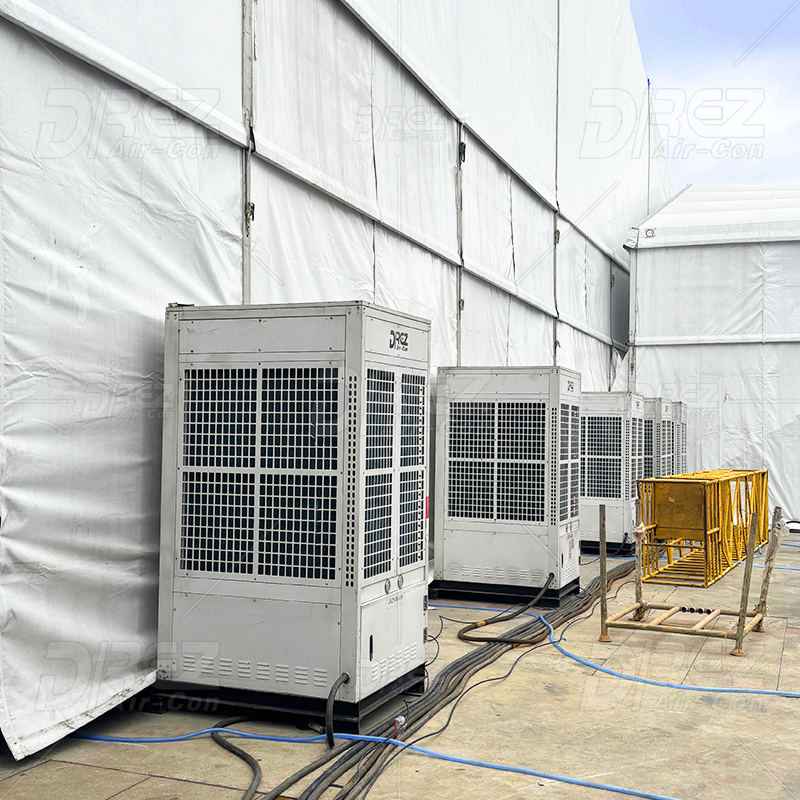
When cooling a tent, many users assume that a standard air conditioner will work just fine. However, tents are fundamentally different from buildings, and using the wrong system often leads to poor cooling performance, wasted energy, and customer dissatisfaction.
This article explains the key differences between tent air conditioners and regular air conditioners, helping you choose the right solution based on real-world needs.
1. Why This Comparison Matters
Users searching for this topic are usually facing one key question:
Can a normal air conditioner effectively cool a tent?
Clear answer: In most cases, no. Standard air conditioners are not designed for tent environments.
2. Key Environmental Differences
The performance gap starts with the environment itself:
- No insulation (tent fabric transfers heat quickly)
- High solar radiation exposure
- Frequent air leakage (doors, seams, temporary openings)
- Unstable internal temperature conditions
Traditional air conditioners are designed for sealed indoor spaces, not open or semi-open environments like tents.
3. Core Differences Between the Two Systems
1) Cooling Capacity Design
- Tent air conditioners: Designed with higher cooling redundancy to handle heat gain
- Regular air conditioners: рассчитаны для стабильных помещений (lower load assumptions)
Conclusion: Regular units are often undersized for tent applications.
2) Airflow and Air Supply Distance
- Tent air conditioners: High airflow, long-distance air supply
- Regular air conditioners: Short airflow range, localized cooling
Conclusion: Regular AC cannot effectively distribute cool air across large tents.
3) Installation Method
- Tent air conditioners: External placement with ducted air delivery
- Regular air conditioners: Indoor installation required
Conclusion: Regular AC installation is often impractical for temporary structures.
4) Adaptability and Mobility
- Tent air conditioners: Designed for quick setup and relocation
- Regular air conditioners: Fixed installation
Conclusion: Regular systems lack flexibility for temporary events.
4. Performance Comparison in Real Use
In real applications, the differences become more obvious:
- Temperature stability: Tent AC performs consistently; regular AC fluctuates
- Cooling speed: Tent AC cools faster due to higher airflow
- Coverage: Tent AC covers large areas; regular AC creates hot and cold zones
Key takeaway: Even if a regular air conditioner technically works, it rarely delivers acceptable results.
5. What Are the Better Alternatives?
Instead of using standard residential or commercial units, consider purpose-built solutions:
Tent-Specific Air Conditioning Systems
- High airflow design
- Adapted to temporary structures
- Fast installation
Packaged Central Air Conditioning Units
- Suitable for large tents
- Stable performance
- Can be combined with duct systems
Portable Industrial Air Conditioners
- Flexible deployment
- Quick response for temporary needs
Ducted Systems
- Even airflow distribution
- Better temperature control in complex layouts
6. Are There Any Cases Where Regular AC Can Work?
In limited situations, regular air conditioners may be usable:
- Small tents (very limited area)
- Mild weather conditions
- Low occupancy
However, even in these cases, performance is often unstable and not recommended for professional use.
7. Common Mistakes to Avoid
- Choosing based on price instead of performance
- Underestimating heat load
- Ignoring airflow design
- Using household AC units for large-scale tents
These mistakes frequently result in insufficient cooling and project failure.
8. Related Topics for Further Reading
- How to design a tent air conditioning system
- How to cool a large tent effectively
- Tent air conditioner cost analysis
- Best cooling solutions for outdoor events
Linking related topics helps build a complete knowledge structure and improves search performance.
9. Final Conclusion
The difference between tent air conditioners and regular air conditioners is not just about power—it is about design logic.
Final answer:
- Tent air conditioners are designed for open, high-load, temporary environments
- Regular air conditioners are designed for enclosed, stable indoor spaces
Choosing the wrong system will not only reduce cooling performance but also increase operational costs.
If you want reliable and efficient cooling for tents, using a purpose-built solution is not optional—it is essential.