
Large-scale events such as exhibitions, festivals, weddings, and temporary industrial setups often face a common challenge: how to provide reliable and efficient cooling in a short time.
Unlike permanent buildings, these environments require fast deployment, flexible systems, and strong cooling performance under changing conditions.
This guide explains how to design a complete temporary air conditioning solution for large events.
1. What Makes Large Event Cooling Difficult?
Temporary event spaces come with unique challenges:
- Short setup time and tight schedules
- Unstable structures (tents, temporary halls)
- High and fluctuating crowd density
- Strong outdoor heat impact
Conclusion: The system must be flexible, powerful, and easy to deploy.
2. Core Principles of Temporary Cooling Solutions
An effective solution is built on three key elements:
- Rapid deployment – quick installation and startup
- Sufficient cooling capacity – handle peak heat load
- Flexible airflow distribution – adapt to layout changes
Key insight: Stability and adaptability are more important than just cooling power.
3. Cooling Capacity Planning
Accurate capacity planning is critical for large events.
- Basic estimation: 400–600 BTU per square meter
- Increase capacity for:
- High crowd density (+10–20%)
- Strong sunlight exposure (+20–30%)
- Heat-generating equipment (+10–15%)
Example: A 1,000㎡ event tent may require 400,000–700,000 BTU depending on conditions.
4. Equipment Options for Temporary Solutions
Different equipment types serve different roles in large event cooling.
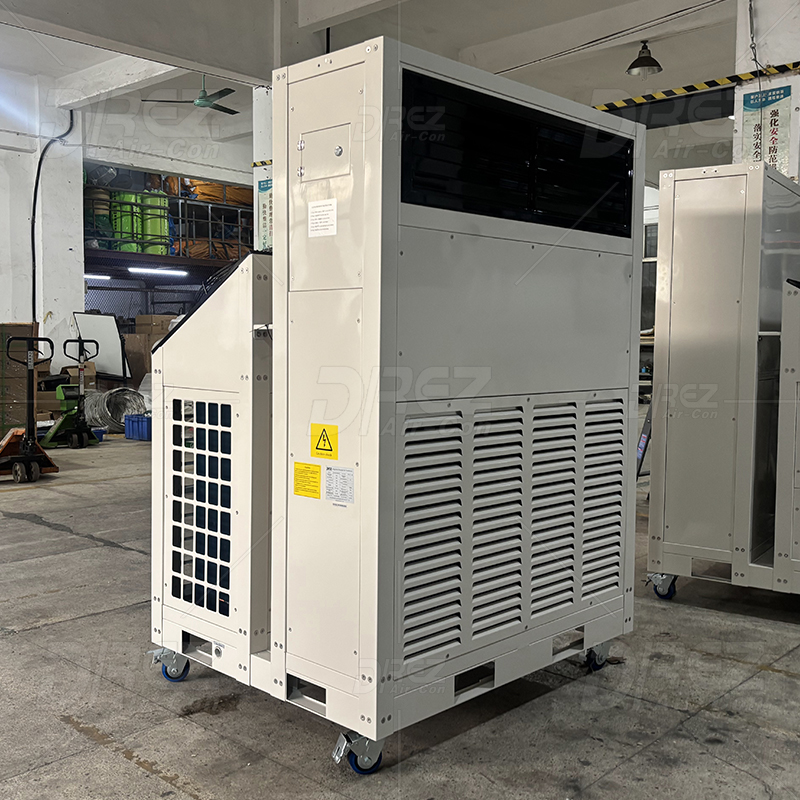
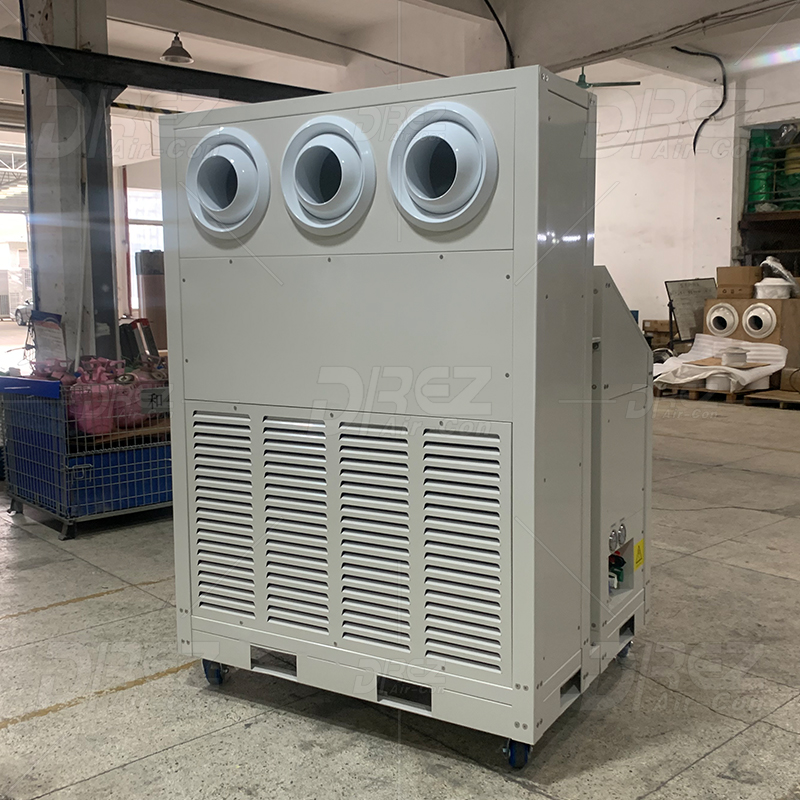
Tent-Specific Air Conditioners
- High airflow and long-distance air supply
- Designed for temporary structures
- Quick installation
Best suited for exhibitions, outdoor events, and large gatherings.
Packaged Central Air Conditioning Units
- Stable and powerful performance
- Suitable for large-scale applications
- Can connect with duct systems
Ideal for events with longer durations or higher cooling demands.
Portable Industrial Air Conditioners
- Flexible and mobile
- Fast deployment
Useful for spot cooling or supplementary cooling.
Ducted Air Conditioning Systems
- Uniform air distribution
- Better temperature control
Essential for large or complex layouts requiring even airflow.
5. System Layout and Airflow Design
Proper layout ensures that cooling reaches all areas effectively:
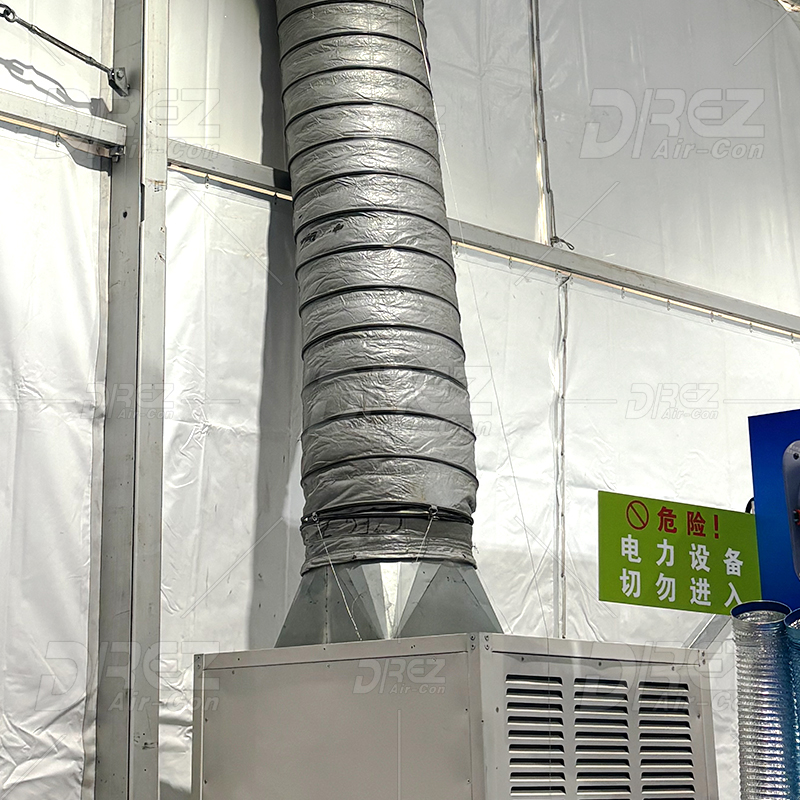
- Distribute units evenly around the event space
- Use ducts to deliver air to central zones
- Avoid airflow dead zones
- Plan return air paths to prevent heat buildup
Conclusion: Good airflow design significantly improves cooling efficiency and comfort.
6. Fast Deployment Process
For temporary events, speed is critical. A typical process includes:
- Site assessment and layout planning
- Equipment selection and allocation
- Pre-installation preparation
- On-site installation and testing
- Pre-cooling before event start
Tip: Starting the system early ensures stable temperature when the event begins.
7. Typical Application Scenarios
Exhibitions and Trade Shows
- Large crowds and high heat load
- Continuous operation required
Recommended: High-capacity tent air conditioners + duct systems
Outdoor Festivals and Concerts
- Open or semi-open environments
- Variable crowd density
Recommended: Combination of tent AC and portable units
Wedding and VIP Events
- Focus on comfort and aesthetics
- Stable temperature control
Recommended: Packaged units with balanced airflow
Temporary Industrial Workspaces
- High heat from machinery
- Long operation hours
Recommended: Packaged central systems or ducted solutions
8. Common Mistakes to Avoid
- Underestimating cooling capacity
- Ignoring airflow distribution
- Using unsuitable equipment (e.g., residential AC)
- Late installation without pre-cooling
These mistakes often lead to poor cooling performance and operational issues.
9. Related Topics for Complete Solutions
- How to design a tent air conditioning system
- How to quickly cool an exhibition tent
- Tent air conditioner vs regular air conditioner
- Cost of temporary air conditioning for events
Connecting these topics helps build a comprehensive solution knowledge system.
10. Final Summary
Temporary air conditioning for large events requires more than just equipment—it requires a complete system approach.
- Plan cooling capacity based on real conditions
- Select suitable equipment combinations
- Optimize airflow and layout
- Ensure fast and efficient deployment
Final conclusion: The most effective solutions combine flexibility, power, and proper system design to deliver reliable cooling under real-world conditions.
For large events, success depends not only on cooling capacity but on how well the entire system is designed and executed.